

Kids Know What They Hate
What surveying 100+ kids taught me about how they actually read.

I’ve been reading and reviewing almost exclusively middle grade books for the last seven years. Each year since 2019, I’ve read 100+ middle grade books, including frontlist and backlist titles. I’m also kind of a nerd about checking on how books are being received, so I’m constantly lurking on Goodreads, Amazon, bookstore websites, the NYT bestseller lists, and yes, in DMs with bookseller friends, and in Instagram comments.
Bestseller lists can be deceiving and Goodreads reviews can be skewed because many times, middle grade books are reviewed by adults who have no experience with the genre and oscillate between thinking kids’ books are “cute” or “so immature.”
I decided I wanted to to hear from the horse’s mouth. So, last week, I put out a call for Kid Reviewers, expecting to receive a trickle of responses (after all, kids aren’t reading much these days, right?) and then to have to beat the marketing drum at least three more times to draw in a few more entries.
Friends, I was wrong.
In less than 48 hours, I was inundated with entries from kid readers of all kinds. The hardest part was that 1 out of every 2 entries was impressive. By the 50th entry, I started to panic because I knew that the more entries I received, the more no’s I’d have to dole out. So I closed the form less than two days after.
Reading these entries was one of the most joyful experiences of my readerly life so far. It was immensely satisfying to receive reviews that matched mine beat for beat in vocabulary, syntax, clarity, and attention to craft detail from readers as young as eight. More importantly, however, I learned so much about the way that kids read from that small sample.
First, a few disclaimers. This was in no way a citable qualitative or quantitative study, but it was a helpful glimpse into the way a tiny sample of kids read. It also goes without saying that the form self-selects for voracious readers, not reluctant ones.
Still, I think writers, parents, and gatekeepers in children’s literature would find these entries insightful. Many of these reviews will be published in our Junior Reviews Digest in the coming months, but I wanted to share my discoveries from the entries with you first.
Finding 1: Kids know what they hate
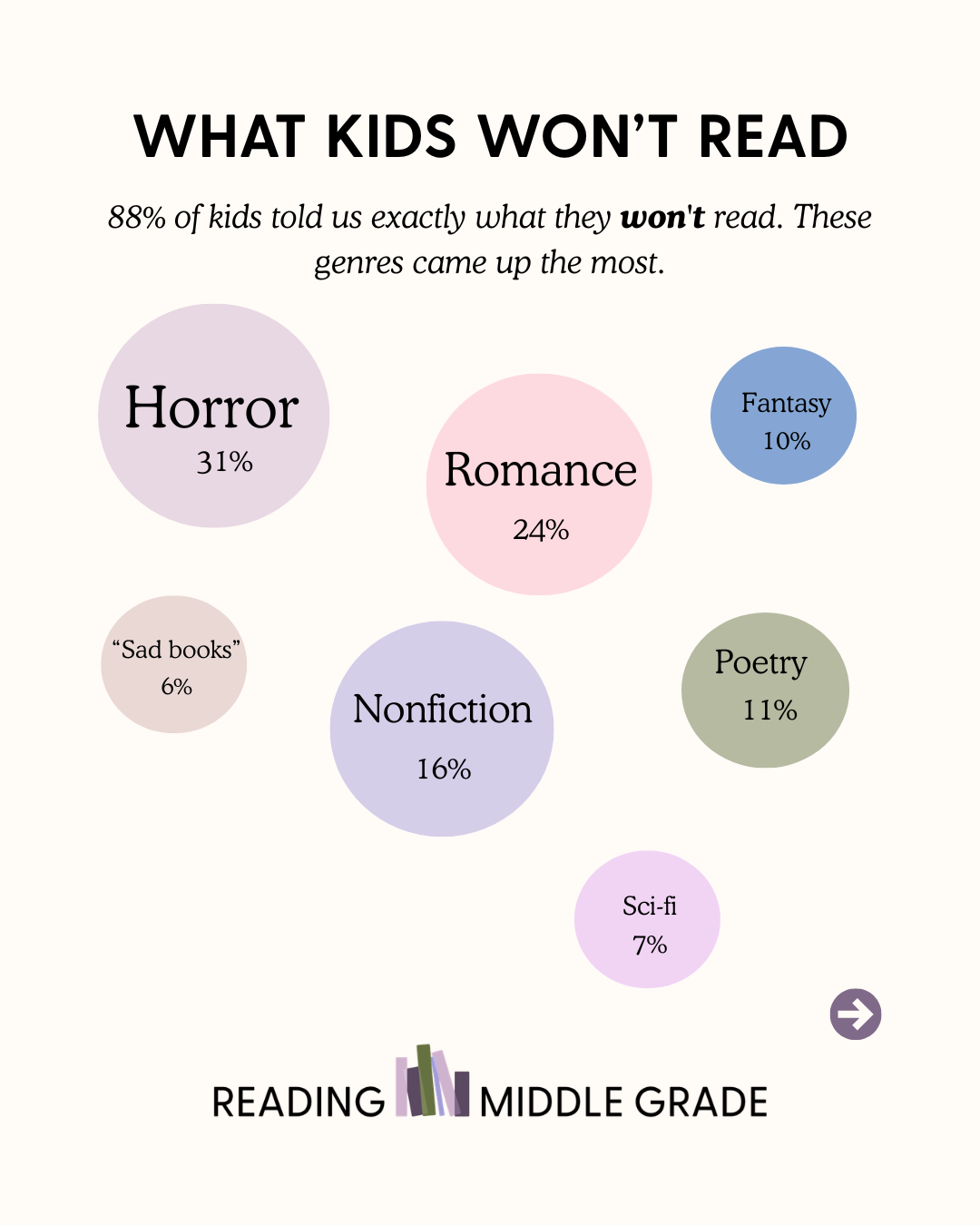
Roughly 80% of all applicants named a specific genre (fantasy, horror, nonfiction, manga, poetry) when asked what they don’t want to read about. Unlike when I asked for their preferred genres, this was not a multiple choice selection, but a short text field where they had to write exactly what they’d rather not read.
They weren’t vague or even simply describing the kind of books they dislike. Most applicants named the genres clearly, with some even saying, “I stay away from” or writing the disliked genre in all-caps.
As adult gatekeepers, we pontificate about what kids like and dislike—often without actually checking with the kid readers themselves. In reality, though, many kids have opinionated reading identities much earlier than adults credit them for. By age 10, most kids know which sections of the library to skip.
I personally find this refreshing and at odds with the idea that kids cannot recognize genre labels. It’s also a strong case for educators, booksellers, and librarians who have yet to organize their classroom libraries by genre to start doing so. This also matters for adults recommending kids books. The “just give it a try!” framing assumes the kid doesn’t know their own taste, when often they very much do. It puts the onus on adults, then, to improve their book matching skills, instead of always trying to lead kids away from what they like.
Many of the kids even stated that they hadn’t read a bad book in ages because they know their preferences. One 13-year-old wrote that she hadn’t disliked any book recently because she’d been staying away from genres she doesn’t like, “like fantasy.” That clarity is something that I, as an adult, only felt brave enough to articulate a decade ago. Now, while I still dabble in my least favorite genres, knowing what I hate brings me indescribable peace in my reading life and reduces unnecessary disappointments—which adults are more able to withstand than kids are.
Finding 2: Nearly half of 12 to 14 year olds are reading YA, or want to
For the last two years, I’ve been noticing that kids are reading up more than ever. In 2020 and 2021, most parents of 11-13 year olds told me that their kids were reading middle grade books. Nowadays, with the advent of TikTok, more and more tweens and young teens are sliding into YA as young as age 10. By age 12, a large percentage is reading almost only YA.
About half of the applicants between ages 12 to 14 signaled YA reading or awareness. They named YA titles outright. Popular mentions were Shatter Me, Divergent, The Hunger Games, The Inheritance Games, and Caraval. Several volunteered language like “I’m more interested in YA but I can still review MG for older kids,” which is its own kind of generous code-switching. They are willing to read down, but they want up. A handful of others said they wanted to try more YA but found it “too sexy.”
Even at the 10 to 11 age band, a handful of readers are already crossing over. Thankfully, most of the YA they’re reading is 12+ YA, but that’s not always the case, with many librarians reporting that young teens are reading Fourth Wing and Colleen Hoover.
What all of this tells us is that the middle grade to young adult bridge is happening earlier than publishing assumes, and the readers themselves know it. They are squeezed between books they’ve outgrown and books that feel inappropriate, and they don’t have a vocabulary for that gap, so many—especially teen boys—just abandon reading altogether or start reading adult fiction.
To be clear, this isn’t a complaint that YA exists. It’s a complaint that the bridge content—older middle grade and younger YA—is thin and hard to find. For a long time, most “older” middle grade protagonists were only between the ages of 10 and 12. But now, very few 12-year-olds want to read about their fellow 12-year-olds. I can’t explain why, but it’s just the way it is.
Unfortunately, not all 12-year-olds are emotionally prepared for real YA. So, we need more books that meet them in that gap, and we need better ways to surface the ones that already exist.
Finding 3: The romance gateway is 10, not 12
Conventional wisdom puts the middle-grade romance turning point at 12 or 13, but the data says it happens younger. Romance love rises sharply between ages 7 to 9 (24%) and 10 to 11 (34%), then grows slightly at 12 to 14 (39%). The big jump is between elementary and the tween years, not between tween and teen.
This matters because romance tends to be abundant on YA shelves (and skew a bit overt and mature) while being scarce on middle grade shelves. In reality, though, about a third of kids in the 10 to 11 band are already actively seeking out romance. They're reading crush-y books, naming books with romantic arcs as their favorites, and looking for more. The 12-and-up framing leaves a real gap for the tween readers who want romance but aren't ready for what YA is offering.
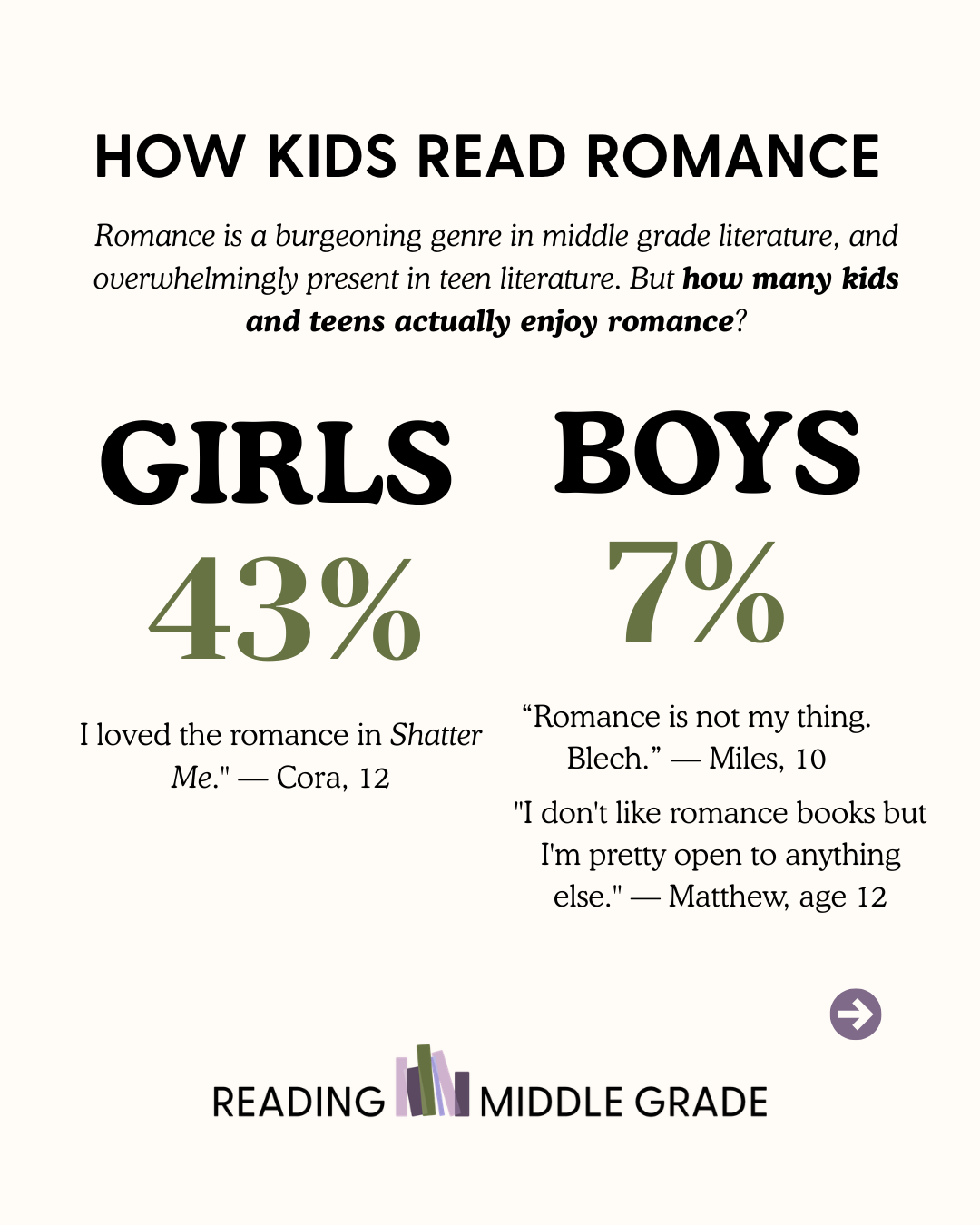
The other half of the curve is just as interesting. Anti-romance sentiment drops sharply between ages 7 to 9 (38%) and 10 to 11 (26%), then again to about 22% through 12 to 14. So many kids who hate romance at 10 don’t grow out of it. They stay anti-romance through the teen years.
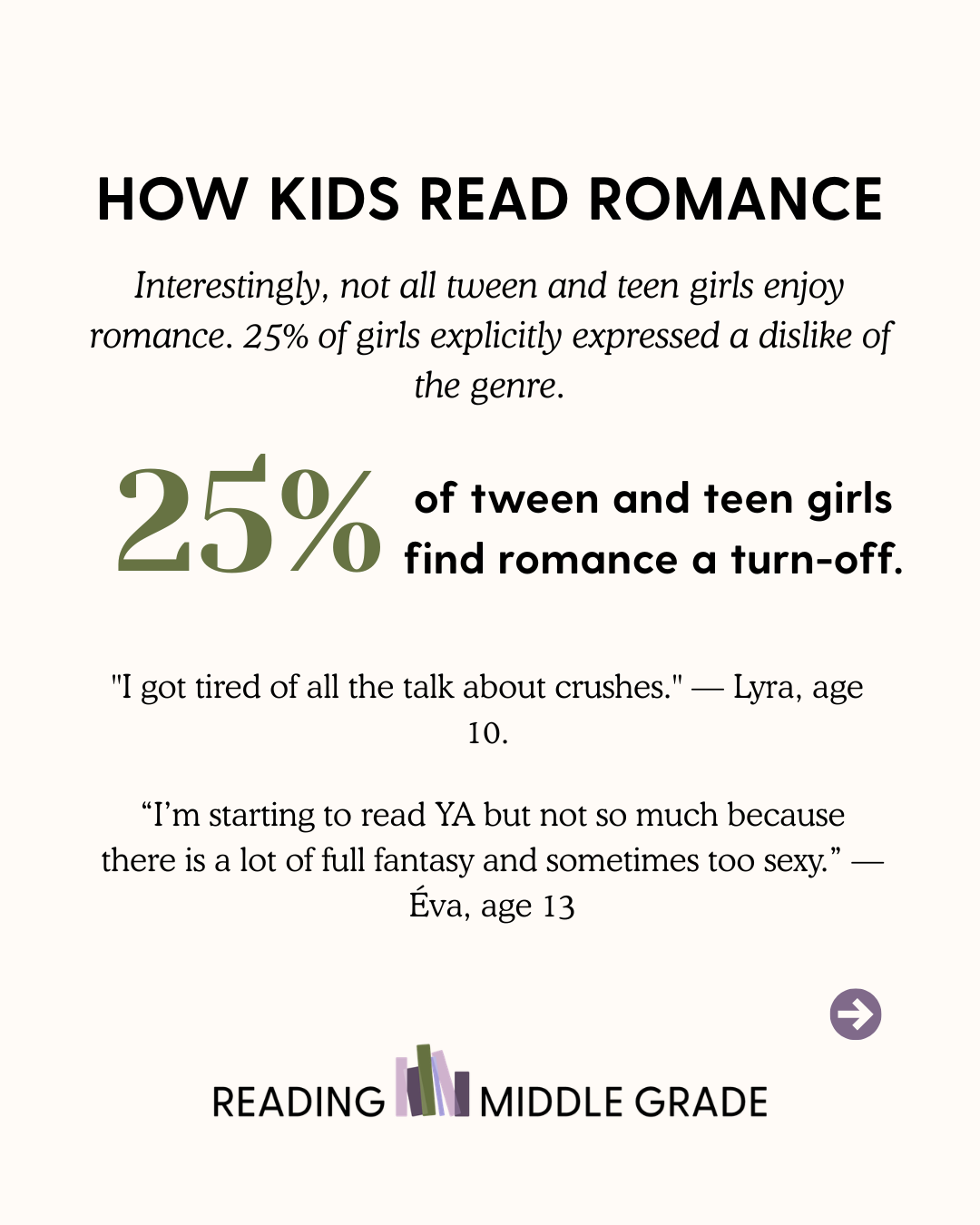
About a quarter of older middle grade readers actively don't want romance, and they tend to feel frustrated entering an age group where most options are steeped in it. Whenever I share that many teens want YA without romance, I get DMs that assume that YA=romance or at least a romance side plot. But it might be time to question that assumption.
Finding 4: Some kids are growing into critical readers
There’s a small but distinctive group of kids in this pool who don’t just name a book they didn’t like. They say why, and the why sounds structural rather than emotional. About 1 in 10 kids ages 10-14 used the word “predictable” in their dislike answer. Several others reached for related craft language: pacing that dragged, characters whose arcs felt “far-fetched,” and overused tropes like repeated male love interests “with dimples.”
An 11-year-old wrote: “I dislike when the plot is predictable because it feels like a waste of time to read the story because I know what is going to happen.” Another 11-year-old, reviewing the first book in a long series said, “I felt like I knew what was going to happen from the beginning, which made it boring. Also, since it’s the first book in a long series, the main characters didn’t even all meet in this book, and I think they should have.”
These aren’t reviews simply focused on how the book made them feel. They’re reviews of how the book was built. The kids using this language are doing something close to literary criticism, and they’re doing it casually, in a couple of paragraphs on an application form, in the same breath as listing their favorite snacks.
This is good news for everyone in this ecosystem. It means the next generation of readers includes a real group of careful, articulate ones who care about craft and can tell you when a book is doing it well. It means authors who get the structure right will earn their loyalty. And it means parents, teachers, and librarians who trust kids to articulate their reading life will find a lot more to work with than the “I liked it” or “it was boring” they might expect.
Finding 5: Don’t conflate poetry and verse novels
Poetry hate climbs steeply with age: 0% at ages 7 to 9, 11% at 10 to 11, and 17% at 12 to 14. Verse novel hate rises gently across the same age bands, peaking at just 6% in the 12 to 14 group—about a third of poetry's rejection rate at the same age. Same form on the page, very different reception. Verse novels are niche but tolerated. Poetry is actively disliked, and the dislike grows as kids get older.
Interestingly, however, no kid in this pool named a specific verse novel as a favorite. The verse novels that did show up appeared only in the dislike column. One 11-year-old wrote about Finding Langston and Home of the Brave: “they didn’t have a lot of story, they were more about developing the characters instead of introducing new conflict.” Still, I think it’s worth noting that this critique is a craft complaint, not a form complaint. This young reader is rejecting the structural choice most verse novels make (see our note on the challenge with verse novels in this post), not the verse format itself. Many kids who reject verse novels often reject them on narrative grounds, the same way they’d reject any slow-moving or overly introspective book.
The publishing industry sometimes treats poetry and verse novels as adjacent forms, marketed in the same breath. For kid readers, they’re different beasts. Verse novels (Kwame Alexander, Jasmine Warga, Margarita Engle, Jacqueline Woodson, etc.) get the protection of being prose with line breaks, and they tell stories the way prose tells stories: with character, plot, conflict, and momentum. Pure poetry doesn’t. It asks readers to slow down, to interpret, to live in image and metaphor without a forward narrative pull, and most middle grade readers, especially the older ones, just don’t want to do that.
The poetry hate curve also closely mirrors the school curriculum poetry exposure curve. Most US schools start ramping up poetry analysis around fourth grade, which is exactly when the kid data starts showing the rise in poetry rejection. I can’t prove the connection with this sample, but it’s worth saying out loud that the way poetry gets taught may be the very thing killing the love for it. Kids don’t hate poetry because it’s poetry. They might hate poetry because of how they’ve been forced to meet it.
Verse novels might benefit from a different kind of “marketing” from poetry, and many educators and booksellers are realizing that. They now pitch these books are prose with fewer words or more white space and once the books are in readers’ hands, the rest is history.
Finding 6: Some of the most-loved books are also the most-hated
This was one of the things that surprised me most when I sorted the entries. The same books show up in both the loved AND the disliked lists, sometimes from kids the same age. A few examples from our pool:
Wings of Fire is a favorite for six kids and was specifically called out as “un-inspired and predictable” by another.
Diary of a Wimpy Kid was loved by five kids and dismissed by another for “not having a lot of story.”
I Survived was a favorite for three readers, but “too scary” for three others.
The Mona Lisa Vanishes was a favorite for one reader, while another older reader said it made her feel like she was “in a Social Studies class.”
The Inheritance Games had one reader raving and another complaining that the puzzles felt “pointless.”
Shatter Me earned rave reviews from two readers but was pegged as “predictable, cheesy, and frustrating” by another reader
As I looked at these results, I kept thinking: There is no universally loved middle grade book. Not even the biggest bestsellers or the books that win every award are loved by all readers. The same novel that changes one kid’s life makes another kid roll her eyes. This is actually freeing news for authors, parents, and educators. The question is rarely “Is this book good?,” it’s “Is this book right for this reader?”
This is also why marketing matters so much in the middle grade space, and why “everyone will love it” is the wrong instinct and the worst way to promote a book. The winning move is finding the readers who will love it, not chasing all readers at once. I’ll be talking about exactly this in my middle grade author marketing workshop on June 6 (tomorrow).
Finding 7: Kids are naming mostly backlist favorites, and that’s a problem for new authors
There’s a popular saying in the kidlit space that we live in the golden era of children’s books, and on the publishing side I believe it. The craft is stronger than it’s ever been, the diversity is real, and the formats are more inventive than they were twenty years ago. There has never been more good middle grade publishing in absolute terms.
But a golden era of publishing and a golden era of reading are not the same thing. What kids actually read is determined by a much narrower funnel than what publishers produce: who hands them the book, what’s on the school shelf, what their older sibling read, what their parent loved at their age. That funnel hasn’t kept up with the abundance.
So you can have the best decade of middle grade ever published, and a world where most kids are still chasing the high of Harry Potter, Dog Man, and Wimpy Kid. Both things are true at once.
When I asked kids to name three books they’ve loved recently, I expected to see some of the buzzy 2025 and 2026 releases. I only saw a handful. The most-named books in the pool were almost entirely backlist titles—many of them long-running series. The top of the list:
Harry Potter by J.K. Rowling (9)
Keeper of the Lost Cities by Shannon Messenger (8)
Percy Jackson and the Olympians by Rick Riordan (7)
Wings of Fire by Tui T. Sutherland (6)
City Spies by James Ponti (6)
Diary of a Wimpy Kid by Jeff Kinney (5)
Number the Stars by Lois Lowry (4)
Warriors by Erin Hunter (4)
Spy School by Stuart Gibbs (4)
Front Desk by Kelly Yang (4)
The Hunger Games by Suzanne Collins (4)
A Wrinkle in Time by Madeleine L’Engle (3)
The Giver by Lois Lowry (3)
The Wild Robot by Peter Brown (3)
The Mysterious Benedict Society by Trenton Lee Stewart (3)
I Survived by Lauren Tarshis (3)
Maze Runner by James Dashner (2)
Dog Man by Dav Pilkey (2)
Mockingbird by Kathryn Erskine (2)
The Liars Society by Alyson Gerber (2)
Each and Every Spark by Claire Swinarski (2)
The Lord of the Rings by J.R.R. Tolkien (2)
Eragon by Christopher Paolini (2)
What Happened to Rachel Riley? by Claire Swinarski (2)
The Vanderbeekers of 141st Street by Karina Yan Glaser (2)
Most of these have been around for years. Some are decades old. Even the more recent ones are established series with multiple books out. And here’s the part that really stood out to me: Almost every single book that was named by two or more kids in our pool is an established backlist series.
Recent 2024 to 2026 releases do show up across the entries, but only as one-off mentions, scattered across the pool. Only two 2024+ frontlist titles—Each and Every Spark by Claire Swinarski and Gerber’s The Liars’ Society series—show up twice. No other new-ish release reached multi-mention status. The buzzy new titles publishing houses have been pushing hard in the last 2-3 years? Each one landed for at most one kid in our group and many didn’t show up at all.
I’ll also flag this anecdotally, because I think it matters: A handful of the recent titles that did get named (The Sweet Spot by Elaine Vickers, Each and Every Spark by Claire Swinarski, Where Ella Went by Laurie Morrison, Jane Stays Dreaming by Britnee Meiser) came from families in my own network who picked those books up because I’d recommended them. So, even the few new releases that reached kids in this pool often landed because of a deliberate, niche channel pushing them, not because the books found those readers on their own.
The disconnect is gaping and frustrating—not because backlist books or classics are bad, but because we’re in the “golden age” of middle grade literature. I can’t entirely point to the reason why this situation exists, but I have a few hypotheses.
Series capture is the first one. Once a kid falls into Wimpy Kid, that’s 20 books already waiting for them. Harry Potter is seven, plus spinoffs. Dog Man is 14 and counting. A great new standalone has to compete not just with other new books, but with the next book in a series the kid already loves and is guaranteed to enjoy. Standalone literary middle grade is fighting series momentum with both hands tied.
Gatekeepers default to safety. Parents and teachers have less time than they used to, and when they recommend a book, they reach for what they themselves loved or what has always worked for kids in their classroom. They praise the “tried and true” recommendations.

The “golden era” abundance overwhelms the average parent and educator, and they retreat to what they trust. Kids name those books back to us when asked because those are the books they actually got handed—not necessarily that the newer books are of lower quality. Newer middle grade authors are competing not just with other new releases, but with the entire weight of every series that came before them.
A lot of “golden era” claims are made by adults reading kid books for themselves. But adult readers of MG are not the same population as kids reading MG, and confusing the two inflates how widely the abundance is actually reaching the audience these books are written for.
Discoverability is a huge problem for middle grade. Unlike picture books which can be read in 10 minutes, middle grade requires more of an investment and passion to read and properly promote. It’s hard to really stand behind or position a book you haven’t read from cover to cover. Middle grade readers also have stronger opinions and less free time than preschoolers who can be a captive audience or elementary schoolers who have more flexibility for readalouds, for example. Add to that the volume of books being published and so many good books get lost in the noise.
I can’t solve all of the discoverability issues in the industry, but it’s a big part of what I’ll be unpacking in my middle grade author workshop on June 6. If you’re an author who’d like to learn more about what you can do to market your book, come join us.
What the dislikes are really telling us
It’s easy to feel discouraged about these findings, especially if you’re a newer author. You might feel overwhelmed if you’re a parent or educator who just can’t keep up anymore.
Let me stop you right there.
These numbers can look like a verdict if you read them that way, but they aren’t a verdict. They’re a map of where the channels between kids and books are working and where they aren’t, and almost every finding points to a discovery you can actually do something about.
If you’re an author—especially a debut or midlist one—the backlist-dominates finding doesn’t have to be a death sentence. It's a description of what’s working. The books that broke through to that backlist position did exactly what the kids in our data set are still telling us they want: a voice that sounds like them, pages that move, hooks that land in the first chapter, visual identity that travels, and series that let them stay in a world they love. Wimpy Kid and Dog Man and Percy Jackson and KOTLC didn't beat the market by luck. They got the craft right in ways the kids in this survey are still validating, years later.
These books also have years of kid-to-kid trust, librarian and teacher recommendations, and the slow accumulation of “the book my older brother loved.” That engine still works. It just doesn’t move at launch speeds anymore. The newer titles that did break through in this pool, like The Sweet Spot and Where Ella Went and The Liars Society, mostly reached kids through one or two trusted voices doing the patient work. That’s still a viable path, but it’s slower than publishers and authors may want it to be.
For authors, this is also an important reminder that middle grade (and kidlit in general) is a long game. More important than hitting the bestseller lists or getting rave trade reviews on day one is gaining staying power among kids and their gatekeepers.
If you’re a parent or educator, please let yourself off the hook about keeping up. Knowing the kid in front of you matters far more than knowing this season’s lead titles. Trust the things they tell you. When a ten-year-old says no romance, she means it. When an eight-year-old wants more pirates and fewer feelings, hand him pirates. The kids who applied to be Kid Reviewers know what they want with a clarity most adults take decades to reach. Your job isn’t to translate the entire publishing catalog. It’s to keep one finger on what the specific kid in your life is actually asking for and try to meet their needs.
If this whole picture worries you, I think the worry itself is a good sign. It means you care about real readers, not the abstraction of “kids who read.” The data here points to something I find truly hopeful: the kids are alright. They’re reading, they have taste, they have opinions, and they want more.
The work in front of all of us is connection work. That’s the work I show up to do.
If you want to keep this conversation going, here are a few places to go next:
My June 6 workshop on middle grade author marketing goes deeper into the discoverability problem and what newer authors can do about it.
The RMG Junior Review Digest launches next Friday with a steady feed of real kid opinions on the new books actually crossing their desks. Our first set of reviews will land next Friday. Subscribe to this newsletter to get access to the first post.
The State of Reading survey for kids and teens ages 8-14 is open online right now—a much bigger version of this questionnaire built on what we learned here. Want to make your kids’ voices heard too? Have them complete this survey about their reading lives.
The State of Reading survey is not just for the kids who love reading; it’s also for the reluctant readers and those who say they hate reading. It seeks to understand what the missing link is for those readers and how we can help them across the bridge, so it’s for ALL kids ages 8-14 who have ever read a book in their lifetime.
Until then, listen to the kid in your house, or your library, or your classroom. They know what they want and that’s the only thing we need to make this work.
If you’re new here

Hi! My name is Afoma and I run the website Reading Middle Grade—of which this Substack is an extension. My goal is to help parents and educators find the books their tweens actually want to read. I write essays about the children's publishing landscape, share weekly agony aunt style recommendations tailored to specific parent requests, and keep authors and gatekeepers abreast of reading trends among kids ages 8-14. You can subscribe below to get new posts in your inbox.
💬 Your turn!
Which of these findings surprised you? Which ones have you encountered with the kids in your life?
⏭️ Coming Next Week
The family looking for their next great readaloud.
🥰 If you love what I do, would you please do me a quick favor?
❤️ Like this post
🔁 Share my work with your network.
If you’re on Substack, restack this post to your friends and followers, and if you’re getting this in your inbox, use the link below to share my Substack with your friends who need good books for kids in their lives.
📚 Want more?
Consider becoming a paid subscriber to my Substack. You’ll gain access to free Book Matchmaking, my monthly new release posts, the RMG Junior Reviews digest, and my annual Summer Reading Guide.
👩🏽💻 Here are some of the most popular posts I’ve written


Thanks for being here,
Afoma.
This post includes affiliate links, and I may earn a small commission when you make a purchase through my links.
As a middle school librarian and a parent of an upper ES student who reads a few years above her age level, I found your survey results thought-provoking. In my school, Novels in Verse are super popular. It is by far the most requested reading type I get asked to provide a reader's advisory for. Once my students read it, they want more! As for getting new books into the hands of my students, my budget is such that I usually need to wait until a book is released in paperback to stretch my dollars, and there is a litany of reviews I can use to justify my purchase to my administrators, as all new books have to go through an approval process. So students don't often get the 'new' stand-alone books for a couple of years. The exception I make for purchasing a hardcover volume is usually tried-and-true series I know my students will read or titles that were specifically requested, e.g., Wings of Fire, Spy Guy, Diary of a Wimpy Kid, Dog Man, etc. My library is genred, and Romance circulates extremely well. This year I had a large group of 8th-grade boys who focused their reading in that area. It started as a dare between a couple of boys and quietly grew from there. I completely agree with your previous post about a dearth of new literature with middle-grade male protagonists. With most teachers recommending Hatchet. It is a good one, but there is a definite hole in the publishing world for this portion of the population.
Listen to what kids like. Applicable to so many things in their life that would make things better for everyone if you simply respected their choices. Great essay!